Now Reading: Who Is My ISP? Find Your Actual Internet Service Provider Name, Not Just a Tech Code
- 01
Who Is My ISP? Find Your Actual Internet Service Provider Name, Not Just a Tech Code

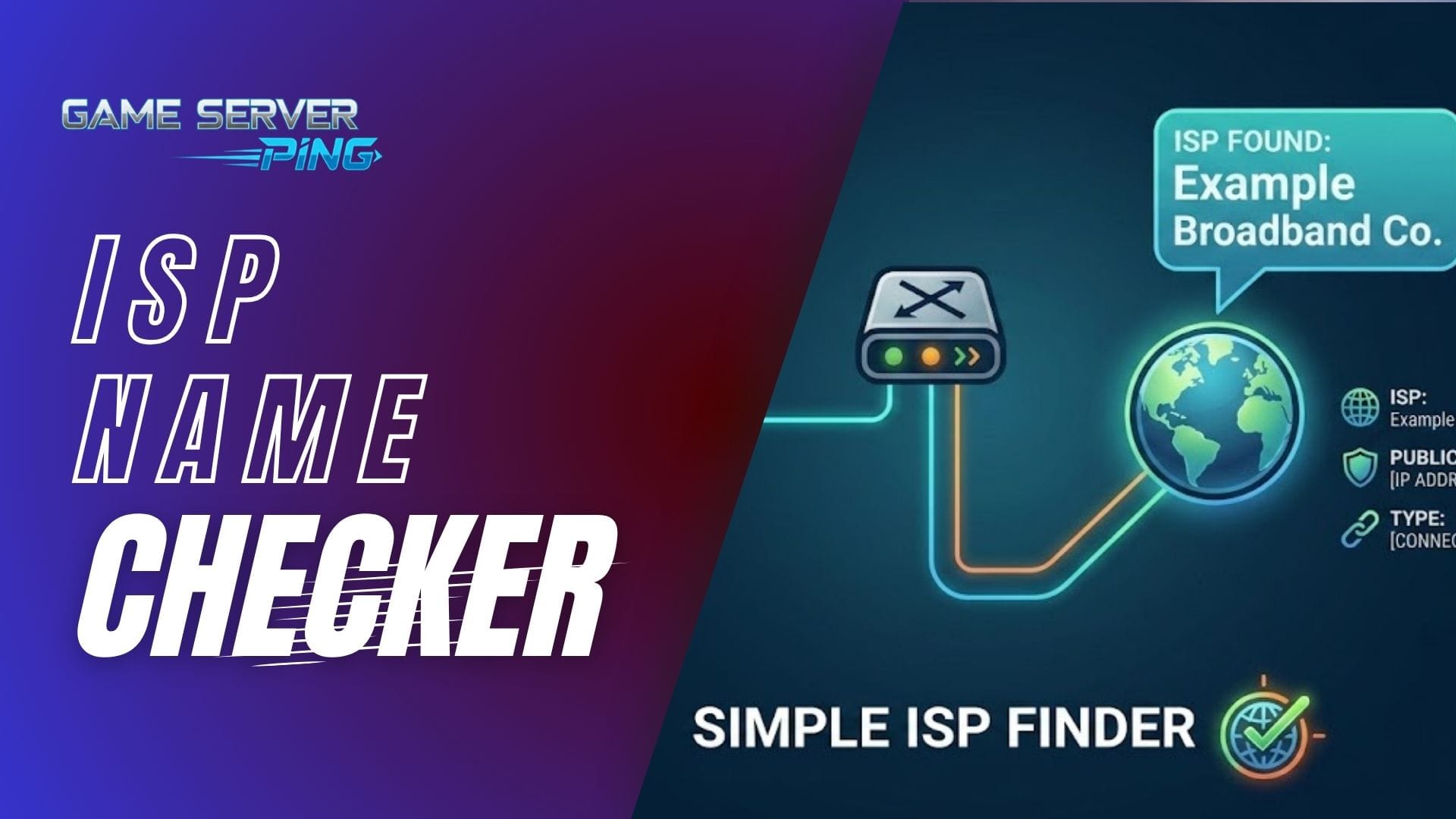

Most tools that claim to tell you “who is your ISP” hand you back something like AS7922 Comcast Cable Communications and call it a day. That raw technical string means nothing to the average gamer trying to figure out why their ping is spiking mid-match in Rainbow Six Siege or why their connection keeps dropping in a ranked game. Our Check My ISP tool is built differently, and that difference matters more than you might think.
Before you dive into diagnosing your connection, it also helps to run a quick internet speed test for gaming to understand your baseline download and upload rates, and pair that with your ISP checker results so you have a complete picture of what your connection actually looks like from a gaming standpoint.
What Makes This ISP Checker Different From Every Other Tool Online
Every other IP lookup tool on the internet pulls your ASN (Autonomous System Number) and your organization name directly from routing databases. What they show you is the raw technical entry, something like “AS5607 Sky UK Limited” or “AS7018 AT&T Services Inc.” and they consider their job done.
That is not useful for most people. A gamer on Sky Broadband in the UK does not search for “AS5607.” They search for “who is my ISP” or “what is my internet provider name” because they want to see a familiar brand name they can actually recognize and do something with.
Our ISP checker tool carries a hand-curated database of hundreds of ISPs mapped across their ASN numbers and organization strings. When the tool detects your connection, it does not just print the raw org field. It cross-references against that database and surfaces the actual consumer-facing brand name you know. If you are on Spectrum in the United States, it shows Spectrum (Charter). If you are on Eir in Ireland, it shows Eir. If you are on Optus in Australia, it shows Optus, not “Singtel Optus Pty Ltd” buried somewhere in a routing table.
This is the single biggest gap in every ISP detection tool that exists today, and it is the reason we built this one from scratch.
What is My ISP Name ? Run the Tool and check it Now
What the Tool Actually Tells You
When you run the check, the tool surfaces eight pieces of information about your current connection in one go.
Your IP Address is your public-facing IPv4 address as seen by the wider internet. This is what game servers, websites, and peer connections see when they interact with you.
ASN / Org is the raw technical identifier for your provider’s network block, shown alongside the cleaned-up brand name so you have both for reference if you ever need them.
Location gives you city, region, and country resolved from your IP. This is useful for confirming whether your connection is routing correctly. Some VPN users or mobile tethering setups can appear to be in a completely different country than where they physically sit.
Timezone is resolved from your IP geolocation data.
Ping shows your round-trip latency to a reference point, colour-coded so you can immediately see whether your connection is in great shape or needs some attention.
Jitter is the variation in your ping over repeated measurements. High jitter is often more damaging in competitive games than a slightly elevated average ping, because it creates inconsistent response times that throw off shot registration and movement prediction.
Packet Loss tells you whether any data packets are being dropped between you and the measurement server. Even 1% packet loss can cause rubber-banding, desync, and lag spikes that make online games feel completely broken.
Connection Advice wraps everything up with a practical recommendation based on what the tool finds.
How the Tool Works
The tool makes a call to an IP intelligence service to pull your public IP, your ASN, and your geographic data. That part is fairly standard, and most ISP checkers stop right there.
What happens next is what separates this tool from everything else out there. The returned organization string gets passed through our internal ISP brand mapping engine, which runs a two-stage matching process. First it tries to match your exact ASN number against a database of known provider ASNs. If your ASN is found, it returns the confirmed brand immediately. If not, it falls back to a keyword scan across the full organization string, checking against known name patterns, subsidiaries, legacy brands, and regional variations.
The result comes back with the provider’s actual consumer brand name, their home region, and a visual identifier, all returned to you in under a second. The whole thing runs through enterprise-grade infrastructure used by some of the largest platforms on the internet, so the lookup is fast no matter where in the world you are running it from.
ISP Coverage by Region
The database covers ISPs across every major gaming market worldwide. Here is a snapshot of the regions and some of the providers currently recognized:
| Region | Example ISPs Covered |
|---|---|
| 🇺🇸 United States | Xfinity (Comcast), Spectrum (Charter), AT&T, Verizon Fios, Cox, T-Mobile, Google Fiber, Frontier, Optimum |
| 🇬🇧 United Kingdom | BT Broadband, Sky Broadband, Virgin Media, TalkTalk, Vodafone UK, Three UK, EE Broadband, Hyperoptic, CityFibre |
| 🇮🇪 Ireland | Eir, Virgin Media, SIRO, Pure Telecom, Sky Ireland, Magnet Networks, Digiweb, Imagine |
| 🇦🇺 Australia | Telstra, Optus, TPG, Aussie Broadband, iiNet, Superloop, Vocus, Kogan Internet |
| 🇨🇦 Canada | Bell Canada, Rogers, TELUS, Videotron, Shaw/Rogers, TekSavvy, Cogeco, EastLink |
| 🇩🇪 Germany | Telekom / Magenta, Vodafone Kabel, 1&1 Internet, Hetzner, NetCologne |
| 🇫🇷 France | Free (Iliad), Orange France, SFR, Bouygues Telecom |
| 🇮🇳 India | Airtel, Jio, BSNL, ACT Fibernet, Hathway, Vi (Vodafone Idea), Spectranet |
| 🇵🇰 Pakistan | PTCL, StormFiber, Nayatel, Transworld, Jazz (Mobilink), Zong, Cybernet |
| 🇯🇵 Japan | NTT / OCN, SoftBank, KDDI / au, NTT Docomo, IIJ |
| 🇰🇷 South Korea | KT Corp, SK Broadband, SK Telecom, LG U+ |
| 🇸🇦 Middle East | STC (Saudi Telecom), Etisalat UAE, du (UAE), Ooredoo, Zain |
| 🇧🇷 Brazil | Claro Brasil, Vivo (Telefônica), Oi, TIM Brasil |
If your ISP is not detected by name, which can happen with very small regional providers or newer network operators, the tool will still return your raw ASN and organization name so you are never completely in the dark.
What Your ISP Says About Your Gaming Connection
Your internet service provider directly affects which game servers you can reach with a low-latency connection and how stable that connection will be over time. Not all ISPs route traffic the same way, and not all providers have the same infrastructure relationship with major game hosting networks.
Providers known for strong peering arrangements with gaming networks, like Verizon Fios in the US, SIRO in Ireland, Hyperoptic in the UK, or Jio in India, tend to deliver more consistent gaming performance than providers that route traffic through multiple intermediary networks. Knowing your ISP by name is the first step to understanding whether your provider is actually the source of your latency problems or whether the issue lies somewhere else entirely.
If you are in the UK on a standard ADSL connection through BT or TalkTalk and connecting to North American game servers, you should expect somewhere in the 80 to 130ms range as a realistic baseline, and no amount of in-game settings will change that. Understanding your provider’s infrastructure and your geographic position helps you set realistic expectations and make smarter choices about server regions. Our Best Server Region Finder is built exactly for this situation. It identifies which game server region will give you the best ping from your current location, based on live data rather than guesswork.
If Your ISP Is Not in the Covered Regions
For players connecting from regions where major ISPs are not as deeply integrated into global gaming infrastructure, parts of South Asia, the Middle East, Africa, or Southeast Asia, the tool still accurately identifies your provider name and location. More importantly, it gives you the information you need to make a better connection decision.
If you are in Pakistan on PTCL and playing a game with servers based in Europe or the US, the tool’s location data confirms what you likely already suspect. The nearest game servers with the lowest feasible ping will be in the Middle East or South Asia region. Connecting to a European server from Lahore on a standard PTCL connection will typically land you somewhere in the 100 to 180ms range. If the game offers servers in the UAE, India, or Southeast Asia, those are your best bet for getting under 80ms.
The same logic applies for players in Brazil, Australia, or South Korea connecting to games that do not have local server infrastructure. Knowing your ISP and location precisely helps you pick the closest available server region with confidence rather than just hoping the auto-select does something reasonable.
Does Your ISP Affect Download Speed Too?
Your ISP plan tier directly affects how fast you can pull game updates and patches. A 20GB update lands very differently on a 100Mbps Xfinity connection versus a 1Gbps Google Fiber or SIRO line. If you want to calculate exactly how long a game download will take on your specific plan, our Game Download Time Calculator handles that. Just plug in the file size and your connection speed and it gives you a realistic estimate. For a broader sense of how your connection speed translates to real gaming conditions, the Internet Speed Calculator for Gaming breaks it down by use case.
How to Actually Lower Your Ping in Games
Once you know your ISP and your baseline connection stats, there are a few adjustments that make a genuine difference to gaming latency.
- Switch from Wi-Fi to a wired Ethernet connection. Wi-Fi adds variable latency, interference, and packet loss that a cable eliminates completely. This single change can drop your jitter from 10 to 20ms down to under 2ms.
- Connect directly to your router. Additional network hops through powerline adapters, mesh nodes, or extra switches each add small amounts of latency. The fewer devices sitting between you and your router, the better.
- Select your server region manually. Most games default to auto-matchmaking, which does not always pick the lowest-latency server. Go into the settings, override it, and pick the region physically closest to you.
| Setting | Impact on Ping | Notes |
|---|---|---|
| Server Region (Manual) | High | Biggest single change you can make |
| Wired vs Wi-Fi | High | Ethernet cuts jitter and packet loss significantly |
| Router QoS / Gaming Mode | Medium | Prioritises game traffic over other devices on the network |
| Closing background apps | Low to Medium | Reduces bandwidth contention on your line |
| Custom DNS (e.g. 1.1.1.1) | Low | Marginally reduces lookup times, not actual ping to game servers |
Using a gaming VPN to find better routing paths can sometimes help too, but only when your ISP’s routing to a particular server region is genuinely poor, which is rare with major providers. For the vast majority of players, Ethernet plus manual server selection is where the real gains are.
Why Knowing Your ISP Name Actually Matters
When something goes wrong with your connection, whether it is packet loss, high latency spikes, or disconnects during peak hours, knowing your exact ISP and plan type is the starting point for every troubleshooting conversation. Support calls, Reddit posts, forum threads asking “why is my ping so high in [game]” all go better when you can say “I am on Spectrum 300Mbps in Texas” or “I am on Eir fibre in Dublin” instead of “I do not know, some internet thing.”
It also matters when you are comparing your connection quality to what other players report. ISP performance can vary significantly by region even within the same provider. Comcast in one US city can perform very differently from Comcast in another depending on local infrastructure investment and network congestion at different times of day.
Our ISP checker gives you that answer instantly, with a real brand name you can actually work with rather than a technical routing code that means nothing outside a network engineering context. That is the whole point, and that is exactly why we built it this way.
Run the tool, know your provider, and stop guessing about your gaming connection.